Linguistic relations with the sequence
We all recognize powerful communicative elements in cinema. Likewise, powerful communicative forms exist within the printed and graphic arts. In the attempt to understand how cinema communicates, many theorists have compared it to language (23/18)1. However, cinema does not function as language in the same way that verbal language does.
One significant similarity between cinema and verbal language is their rigid sequential structure. Cinema typically requires the spectator to enter the narrative at the beginning, move through a middle, and arrive at a conclusion. The experience unfolds in time and cannot be apprehended simultaneously in its entirety.
In contrast, communicational structures in the graphic world—such as a poster, a picture book, or a web page—operate differently. These visual artifacts often allow for non-linear engagement. The viewer may navigate them freely, selecting points of entry and constructing meaning through spatial relationships rather than temporal progression.
In this section, I aim to compare the communicational structure of cinema with that found in graphic forms in order to identify similarities and differences. Furthermore, I seek to determine whether this communicational structure is a direct visual manifestation of what might be called the “perfect image,” or whether it emerges from a deeper structural essence inherent in the communicational object itself.
Two major fields within linguistics and semiotics—structuralism and post-structuralism—cast important light on this dissertation. Ferdinand de Saussure, the Swiss linguist often considered the founder of modern linguistics, was among the first to systematically investigate the underlying structures that govern language and other systems of signification.
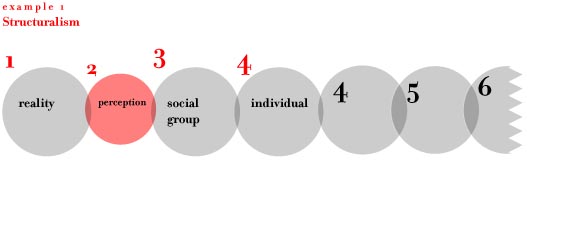
Structuralism is concerned with the way units of language function together to produce meaning (web / 4)2. It proposes that meaning does not arise from isolated elements but from the relational structures that organize them. According to structuralist thought, these organizing structures are shaped both individually and collectively, as part of a broader social system.
In linguistic terms, this suggests that the structure of what we perceive is subsequently translated into the structure through which we communicate. Such structures are deeply influenced by collective behavior and shared conventions (web / 10) 3 (Example 1).
(Example 1)
-
18
Film is not a language, but is like language, and since it is like language, some of the methods that we use to study language might profitably be applied to a study of film.
> Structure > Language
How to Read a Film: The World of Movies, Media, and Multimedia : Language, History, Theory
by James Monaco ↩︎ -
4
By focusing on the system itself, in a synchronic analysis, structuralists cancel out history. Most insist, as Levi-Strauss does, that structures are universal, therefore timeless. Structuralists can’t account for change or development; they are uninterested, for example, in how literary forms may have changed over time. They are not interested in a text’s production or reception/consumption, but only in the structures that shape it.
> Language > Structuralism/Poststructuralism ↩︎ - (Missing text) ↩︎
Leave a Reply